

Approbation in Germany: How the Process Differs for EU vs Non-EU Doctors
Autor: Match Doctors
10. Dezember 2025
If you’re a doctor trained outside of Germany and planning to work here, you’ll need to obtain a German medical license, officially called Approbation. The process may seem complex—especially if you’re unfamiliar with the German healthcare system—but with the right steps, it’s completely manageable.
In this 2026 guide, we’ll walk you through how to get your medical license in Germany as a foreign doctor, from language preparation to final approval.
Overview: How to Get Approbation in Germany
Here’s a bird’s-eye view of what the journey looks like:
- 1.German language skills
- 2.Document preparation
- 3.Application submission
- 4.Recognition of your degree
- 5.Medical exams (Fachsprach- and Kenntnisprüfung)
- 6.Final approval for Approbation
Now let’s go into each step in more detail.
1. Learn German (B2 or C1 Level)
Language is one of the biggest barriers, so start here as early as possible.
- You’ll need at least B2 in general German and C1 in medical German
- Most authorities ask for TELC B2 and TELC Medizin C1, or equivalents
Pro tip: If you're planning to take the Fachsprachprüfung, focus on medical terminology, patient communication, and documentation phrases early on.
2. Collect and Translate Your Documents
You’ll need to prepare several documents to apply for Approbation. These usually include:
- Medical diploma and transcript
- Proof of internships/clinical rotations
- Passport and CV
- Language certificates (B2 and C1)
- Good conduct certificate (from your home country)
- Health certificate from a German doctor
3. Submit Your Application
Applications must be sent to the Approbation authority of the Bundesland (state) where you want to work.
- Each state has its own procedure and forms
- You can usually apply by post; some now allow partial digital submission
Make sure to double-check whether you need an appointment or additional local requirements
4. Wait for Degree Equivalency Check
The authorities will review your education to determine if it is equivalent to a German medical degree. If you obtained your degree outside the EU, you will also need to pass the Kenntnisprüfung and the Fachsprachprüfung. If you obtained your degree within the EU, the Fachsprachprüfung alone is sufficient.
5. Pass the Required Exams
You’ll usually need to pass two exams:
- Fachsprachprüfung – medical German, communication, documentation, role plays
- Kenntnisprüfung – internal medicine, diagnostics, pharmacology, German clinical reasoning
Fachsprachprüfung
- A medical language exam testing your ability to communicate with patients and lleagues
- Required in nearly all cases
Kenntnisprüfung
- A medical knowledge exam for those whose degree is not recognized as equivalent
- Covers internal medicine, surgery, pharmacology, diagnostics, and more
We offer expert-led preparation courses for both: Our courses are trusted by international doctors across Germany. Contact us to join or learn more.
6. Receive Your Approbation
Once you've completed all requirements and passed the necessary exams, you’ll receive your Approbation certificate, which allows you to:
- Work anywhere in Germany as a fully licensed doctor
- Apply for specialty training or permanent employment
- Earn a significantly higher salary compared to those on temporary permits
Congratulations – you’re now officially a doctor in Germany!
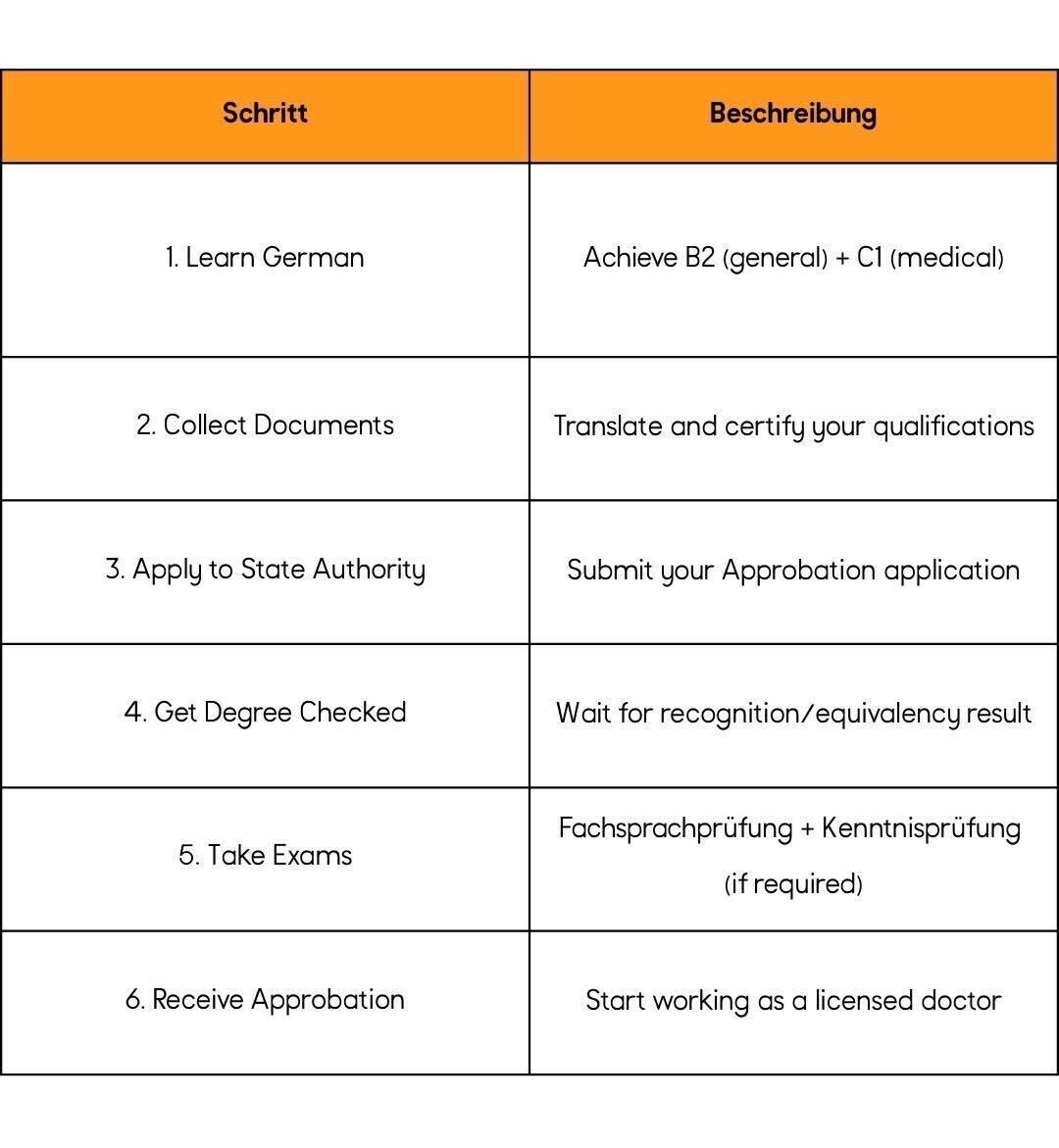
Summary: Step-by-Step Checklist
Final Tips for Success
- Start your language learning early – it’s the #1 challenge for most doctors
- Choose your Bundesland wisely (some have faster processes than others)
- Be patient—Approbation is not quick, but it’s 100% possible with persistence
Ready to pass the Fachsprach- or Kenntnisprüfung?
ur preparation courses help you:
- Master medical German for the Fachsprachprüfung
- Review core subjects and clinical reasoning for the Kenntnisprüfung
- Study smarter with real exam simulations and personalized
Get a free consultation today!